
Book Release from Pastor Ed Neufeld
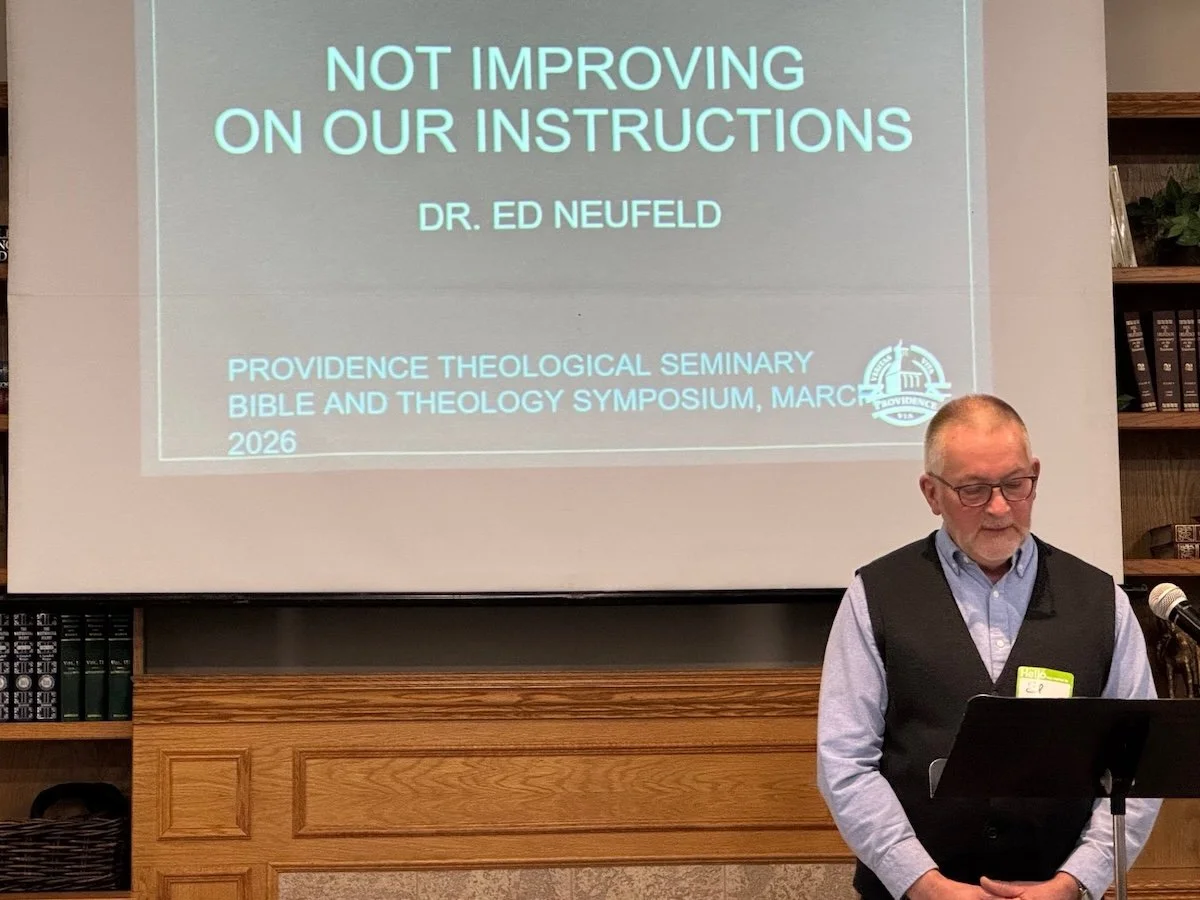
Congratulations to Pastor Ed Neufeld, from Kleefield Community Church in Kleefield, MB, on the release of his book Not Improving on Our Instructions. Ed has been an active part of the Theology for the Ordinary group within the CBWC for the last several years. This book is a direct result of the podcast with the same name, in which Ed and Mark Doerksen unpack themes related to the early church and our mission as the church today.
When asked what his book is about, Ed had this to say:
This book asks one question and gives one answer. Question: based on the New Testament, what is the main thing God wants churches to do? In different words, what should churches concentrate on? What is God’s priority for believing congregations? Answer: God wants us to love each other. He wants us to take care of each other, forgive each other, and serve each other. He wants us to live with each other the way we’ll live together after the Lord returns.
Has this ever actually happened? Have believers lived together this way?
The closest the New Testament gets to this is the life together of the 3,000 at the end of Acts 2. Those six verses give us the New Testament’s ideal church. It’s entirely about their life together. I am not sure it has happened like that since then.
What persuaded you that loving one another was the church’s first priority?
Thirty years ago, my friend Ron Shiels preached through 1 John. He told me that loving each other was the most important thing for believers to do. I didn’t know if he was right or not. I decided to look at the New Testament Letters, because they were written directly to the churches. If Ron was right, I’d find it in the Letters. In Paul, Hebrews, James, Peter, and John, I found regular emphasis on our life together.
That’s the first half of what convinced me. The other half is what the New Testament Letters did not say.
So, what do the Letters not say?
The Letters don’t call congregations to outreach, to evangelism, to sharing the gospel, or to inviting unbelievers to church. It’s hard to believe, isn’t it? The Letters don’t call believers to meet the needs of unbelievers around them, or to improve society.
Every New Testament church had big social problems in their own city: violence, injustice, abuse, poverty, oppression, neglect, and so on. All this was in every city in the Roman empire. But the Letters do not tell churches to make the rest of their city a better place.
When these problems happened in the church, the Letter writers were scathing. Such things must not happen among the brothers and sisters. But the writers didn’t seem to have much interest in improving the surrounding city. This silence affected me deeply. That’s the second half of what convinced me that “love one another” was the most important thing.
While I’m on the silence in the Letters, they never mention size; if a church is small or large or growing or shrinking. It never comes up. No church was commended or corrected for such things. We don’t even know which churches were which. Numbers were irrelevant.
So, back to outreach: are you telling us to ignore the needs of unbelievers right around us? Is God telling us to walk past our neighbours in trouble?
No, no, I’m not saying that. Remember the question at the start: what is the main thing God wants? What should we concentrate on? What is God’s priority for congregations? Not Improving on Our Instructions is not about all the things God tells us to do; it is about the one thing God says is most important. Paul writes, As you have opportunity, do good to all, especially to the household of faith.” In another place he says, “Always pursue what is good with one another and with everyone.” “May your love abound for one another and for everyone else.” We do good to all. The congregational life of love spills over. But the centre is one another, not everyone else.
What made you decide to write a book?
I wrote because I could not find anyone saying what seemed to me such an obvious thing. I wrote because I listened to leaders who had such different views of what churches should do. Some thought that loving each other could not possibly be enough. Surely, we should do more. That’s why this is called, Not Improving on Our Instructions. What would our churches look like if we did not improve on our instructions? What if we just did what they said?”
Who are you writing for?
This is a lay-level book; there is no technical academic language except in a few endnotes. It’s not really a popular book either, though. It doesn’t have heart-warming stories or anecdotes. It’s mostly Bible exposition. I’m not sure that was ever popular.
My reader needs to be asking two questions: ‘What should churches do?’ And ‘What does the Bible say?’ I have in mind all levels of local church leaders, pastors and lay leaders, as well as anyone in parachurch ministry. There are study questions on each sermon at the end, for group study. I wish I’d had this text when I was a Bible college student.
Why did you write a book of sermons rather than a book of chapters?
You want the truth? I don’t know how to write a book. I am not that good. I wrote a thesis with chapters and a dissertation with chapters, and those went alright, but when I tried to write a book about these things, it flopped. My efforts did not please anyone else, and they didn’t please me either. So, I started over. On the suggestion of my brother Les and my friend Mark, I wrote a book of sermons. I have used all of these sermons in my home church, pretty much as you will read them.
I have to talk about Marilyn here, my wife. She edited all these sermons ruthlessly, and then she went through them all again. She didn’t change the content, but she reorganized it and clarified and cut out repetitions. Marilyn made these a lot more readable.”
You lead a church in Kleefeld, MB. How has your church responded to this?
Our church has been great. I taught these things as I was learning them. We went over the Scriptures together, and the people were all in. They took it and ran with it. I asked the other elders if I could make working on this book a part of my pastoral duties, and with no hesitation they said yes. This book is self-published, which takes money, and our church paid sizeable piece of the publishing cost because they want to share what they’ve learned.
Sometimes we’re a shining example of this message, and at other times we fail miserably. But we hang on to the God who works in us to will and to do what pleases Him.
If you’d like to engage in this topic more, please check out the podcast ‘Not Improving on Our Instructions’. Ed has also directed us to his website https://www.notimprovingonourinstructions.ca/
